
Choose insulation that fits
Best Insulation for Ceilings
Choose ceiling insulation that fits your home, meets the required R-value and makes sense for the area you need to cover.
In this guide
The short answer
What is the best insulation for ceilings?
For a typical South African home with an accessible roof space and a flat ceiling, glasswool is our first choice when you want a non-combustible ceiling roll. Choose a roll that fits at its full thickness and delivers the R-value your project needs.
Compare the Knauf and Aerolite rolls below for coverage and total cost. Polyester can also suit ceilings where the specific roll meets the project’s thermal and fire-performance requirements.
Compare the materials
Compare insulation for ceilings
Start with how the insulation will sit in the ceiling. A flexible roll laid over ceiling boards solves a different problem from a board fitted into a shallow assembly or a reflective layer beneath roof sheeting.
| Material | When to consider it | What to check |
|---|---|---|
| Glasswool | An accessible ceiling void with enough depth for a full-thickness roll. | Declared R-value, coverage, the product’s fire classification and the manufacturer’s handling instructions. |
| Polyester | A suitable ceiling where you prefer a soft fibre roll. | Compare the R-value at the thickness that fits. Check fire performance and application approval for the exact roll. |
| Rigid boards | A specified ceiling system where depth, access or the finish makes a loose roll impractical. | Fixings, joints, moisture, fire protection and compatibility with the ceiling assembly. |
| Reflective foil | A roof assembly designed to reduce radiant heat across an air space. | Required air space, facing, condensation and the performance of the whole assembly. |
Glasswool or polyester? Compare the rolls at the R-value you need. Two rolls of equal thickness can have different R-values. For brand-by-brand specifications, use the product comparisons.
Our glasswool shortlist
Two rolls to compare for your ceiling
If your ceiling can accommodate the full 135 mm thickness and R3.38 suits your project, start with these two glasswool rolls. Both have an A1 fire classification.
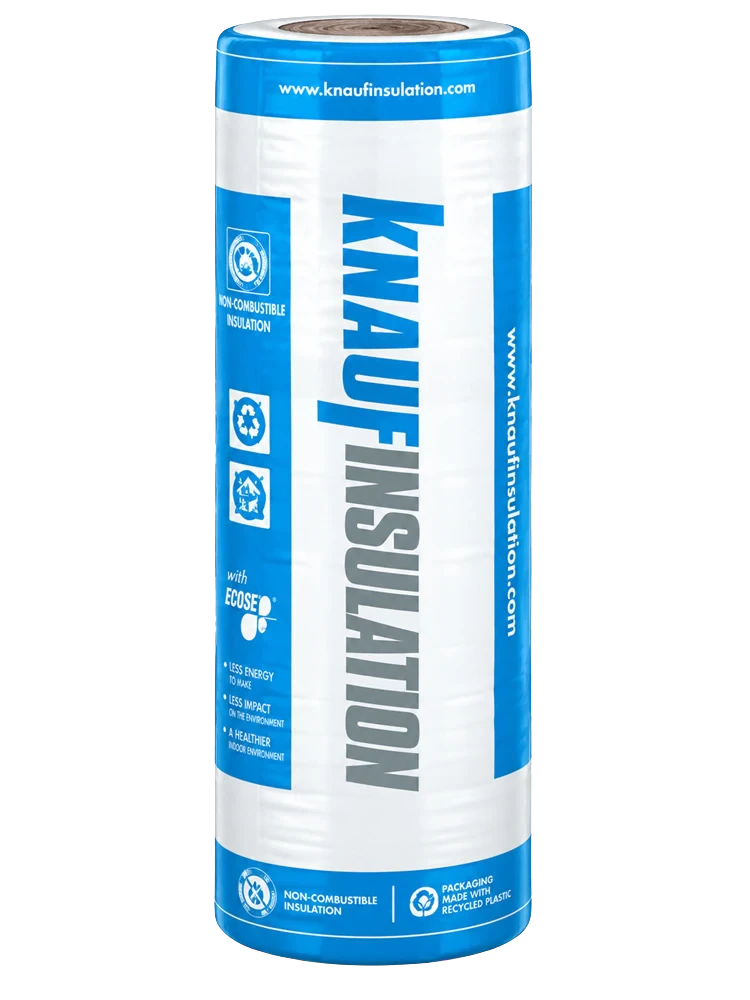

Knauf covers 3 m² more per roll. Use the coverage example to compare how many rolls you’ll need and what the whole ceiling will cost.
Start with your ceiling
Choose for the ceiling you have
- Older home with a clear roof void
- Check access, usable depth and the condition of the ceiling. Repair leaks before insulating. Have existing insulation checked for damp, damage or gaps before deciding whether to top it up or replace it.
- Flat, sloped or hard-to-reach ceiling
- Find out where the insulation can sit and how the assembly manages moisture. Ask a qualified installer to assess the build-up. The same roll that suits an open roof void may be impractical here.
- Hot rooms below a metal roof
- First establish whether you can insulate at ceiling level, roof level or both. Bulk ceiling insulation slows heat transfer into the room. A suitable radiant barrier can help reduce radiant heat in the roof system. Use our guide to choosing insulation for roofs to compare both positions.
- Noise is the main concern
- A fibre roll can absorb sound inside a cavity. Reducing sound between rooms also depends on the ceiling layers, seals and paths around the assembly. Use the soundproofing guide for that decision.
Where does a ceiling roll sit?

- Roof covering
- Roof void
- Bulk insulation
- Ceiling lining
Check depth and thermal performance
How thick should ceiling insulation be?
Start with the thermal requirement for the whole roof and ceiling assembly and the usable depth at the tightest point. Then choose a product whose declared R-value and installed thickness fit the design. A product R-value describes the roll itself. The assembly includes the other layers and construction details.
A 135mm roll can be a useful option where its declared R-value and depth suit the project. For example, 135mm Knauf and 135mm Aerolite each list a product R-value of 3.38 m²·K/W in their South African literature, but their rolls cover different areas. Compare the exact product rather than choosing by thickness alone. See the R-value guide for the distinction.
Plan for continuous coverage and keep insulation at its specified thickness. Have an installer verify ventilation, electrical and fixture clearances, access and the condition of the ceiling before work starts.
Work out the coverage
Compare cost for the whole ceiling
Measure the ceiling area you intend to cover. Divide it by the coverage per roll and round up. Allow for cuts and awkward spaces, then compare the total material cost, delivery and installation across suitable options.
Example for a 60 m² ceiling
At 9 m² per roll, you need 7 rolls before cutting allowance. At 6 m² per roll, you need 10 rolls. Compare the cost for the number of rolls the job needs. Use the shop prices for the current figures and minimum quantities.
Before you buy
Common ceiling insulation questions
What is the best ceiling insulation for summer heat?
For a typical flat ceiling under an accessible roof void, a correctly fitted bulk roll helps slow heat entering the room. If the roof is a major source of radiant heat, assess whether the roof assembly can also use a reflective layer with the required air space.
Can I put new insulation over old insulation?
A top-up can work when the existing insulation is dry, sound and suitable to keep. Check for gaps, water damage and crushed material first. Ask the installer how the combined layers will fit around vents, access and ceiling fixtures.
What if there’s no roof space above my ceiling?
Have the ceiling assessed before buying rolls. The work may call for a compatible board system or access from another side of the assembly. Ceiling height, moisture and fire performance affect the choice.
Is reflective foil enough on its own?
That depends on the complete roof design and the thermal performance it achieves. A reflective layer needs the specified air space. Compare the assembly’s performance with what the project requires before deciding whether a bulk layer is also needed.
Product data from the Knauf datasheet and Isover. Building retrofit guidance from TIPSASA.
Plan your ceiling project
Find ceiling products and installation
Explore ceiling rolls and fitting options for Johannesburg, Centurion and Pretoria.